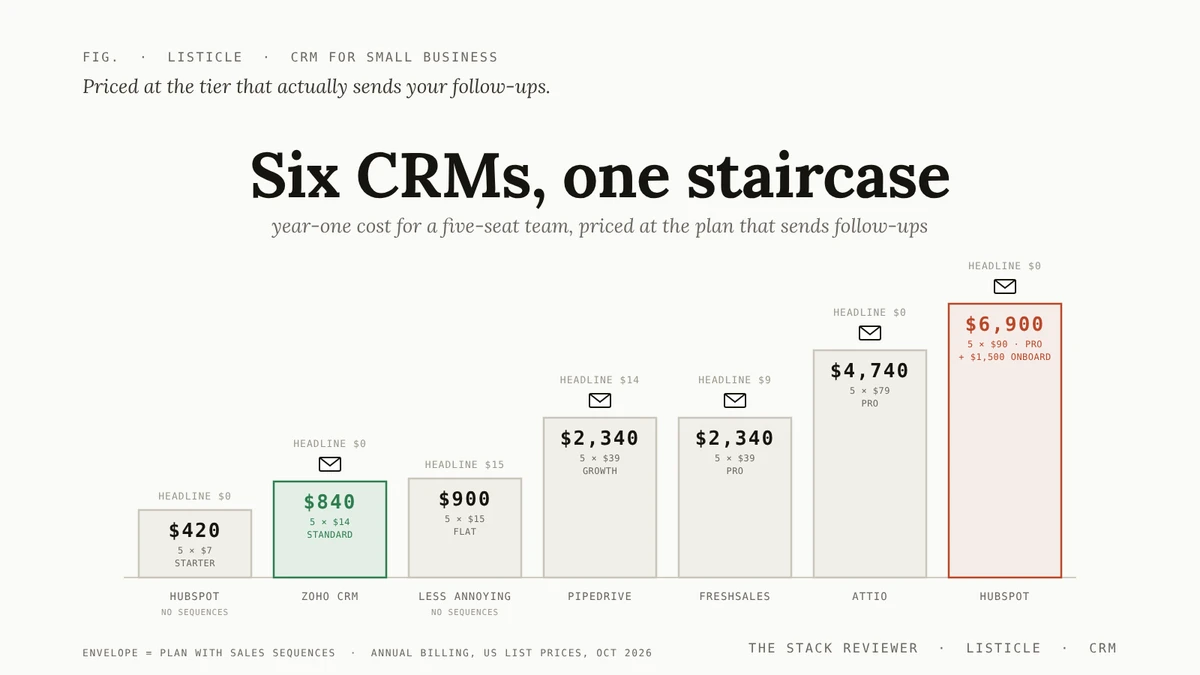
The best CRM for a US small business depends on your sales model: Bigin is the top pick for micro-businesses seeking low costs without bloat, Zoho CRM leads for scaling teams needing mobile field tracking, Salesforce Starter provides the best turn-key suite with built-in agentic AI, Monday.com excels in pipeline dashboards, and Salesmate suits outreach teams needing unlimited contacts. Industry research demonstrates that CRM deployments return an average of $8.71 for every dollar spent, underscoring the direct financial return of replacing manual record-keeping with structured pipeline tracking. Data from the Small Business Administration indicates that small enterprises account for 54% of all commercial sales in the United States, making structured deal follow-up essential for lean sales operations looking to protect revenue and build predictable customer pipelines.
Core Criteria for Evaluating Small Business CRMs
The best small business CRM must balance low per-seat pricing, rapid adoption, and direct workflow automation. For US teams, essential criteria include keeping costs under $20 per user monthly to avoid feature bloat, mobile offline capabilities, automated lead routing, and native contact-interaction tracking without requiring full-time IT administrators.
According to industry research, CRM adoption reaches 91% among companies with more than 11 employees. Despite this high penetration, small teams frequently stumble by purchasing platforms designed for large corporations. Selecting software priced beyond $20 per user per month often burdens a small business with excess configuration layers, custom database scripting, and administrative maintenance that employees actively resist using. Operational research demonstrates that software delivering an $8.71 return per dollar invested does so by automating core administrative tasks rather than adding theoretical complexity.
To ensure steady day-to-day use, small business owners evaluating software should verify four fundamental capabilities:
- Direct Lead Capture and Routing: The system must ingest leads from web forms, incoming phone lines, and email inquiries, routing them to the correct rep immediately to prevent inquiries from going cold.
- Visual Pipeline Management: A clear, drag-and-drop deal board that provides business owners an instantaneous view of active proposals, stalled conversations, and projected monthly cash flow.
- Activity Scheduling and Follow-up Triggers: Native task automation that alerts sales reps when a proposal remains unanswered, eliminating lost revenue caused by forgotten outreach.
- Accessible Per-Seat Pricing: Transparent subscription tiers that allow teams to add users without triggering mandatory service packages or punitive contract minimums.
Top US Small Business CRMs Compared
Selecting the right sales platform requires evaluating monthly pricing, user capacity, and specific workflow capabilities against your team’s day-to-day sales motion. The table below details starting costs, software ratings, and target business models across the leading small business CRM options.
CRM Platform |
Starting Price (per user/mo) |
Standout Strength |
Free Tier Availability |
Best Suited For |
|---|---|---|---|---|
Bigin |
Under $20 (caps at $21) |
Lightweight pipeline tracking |
Free edition available |
Startups and budget-conscious micro-teams |
Zoho CRM |
Under $20 standard plans |
Mobile field tools and task automation |
Free for up to 3 users |
Scaling teams and outside field sales reps |
Salesforce Starter |
$25 |
Integrated sales, service, and built-in AI |
30-day free trial |
Small teams wanting an all-in-one suite without IT staff |
Monday CRM |
Under $20 entry tiers |
Customizable widget reporting dashboards |
14-day free trial |
Teams requiring visual project and pipeline reporting |
Salesmate |
Under $20 entry plans |
Unlimited contact management |
15-day free trial |
High-volume outbound sales and outreach desks |
OnePageCRM |
$9.95 |
Action Stream next-step sales model |
21-day free trial |
Solopreneurs and focused call-driven sales teams |
These platforms establish clear entry thresholds, enabling businesses to digitize customer records and deal tracking while avoiding the severe tier jumps and administrative bloat common in enterprise platforms.
Bigin: Best for Micro-Businesses on a Budget
Bigin earned a 4.6-star rating from Forbes Advisor, which identified the platform as the premier option for lean commercial teams operating under tight financial constraints. Designed specifically by Zoho as a dedicated pipeline CRM for micro-businesses and early-stage startups, Bigin removes the dense operational clutter of traditional software in favor of straightforward deal boards.
“Our research found that Bigin is the best small business CRM for teams on a budget, earning a 4.6 star rating from our research team.”
A notable strength of Bigin is its strict pricing ceiling. The platform caps its most feature-packed tier at $21 per user per month. This cost structure protects early-stage companies from software price inflation while granting access to multi-pipeline management, activity auditing, and automated stage movement. Rather than forcing users through complex relational database setups, Bigin structures contact histories directly around visual deal cards.
The platform is ideal for operations transitioning off spreadsheets that require immediate visibility into active customer quotes. When a growing company eventually requires advanced multi-department lead scoring, deep custom module creation, or specialized territory management, it can transition directly from Bigin into full Zoho CRM without rebuilding contact architecture or losing historical communications.
Zoho CRM: Best for Scaling Teams and Field Sales
Zoho CRM holds a 4.8-star rating from Forbes Advisor and provides an expansive suite of sales management tools designed for expanding businesses. According to an independently documented customer benchmark, teams adopting Zoho CRM report significant operational acceleration:
“With Zoho CRM, we experienced a 65% increase in our sales pipeline. We also managed to reduce our lead to real prospect time by 60%, which is huge.”
These operational outcomes align with industry data that recorded conversion rate increases of up to 300% following structured CRM deployment. Complementary industry research found that companies utilizing dedicated customer management systems achieve 47% higher customer retention rates by keeping historical client requirements readily accessible to all team members.
For US service providers, trade contractors, and distributed field reps, Zoho CRM provides purpose-built mobile features. Its mobile application includes GPS geotagging, enabling outside sales representatives to check in at prospect facilities, log on-site notes, and verify customer visits automatically. To maintain data continuity in areas with limited mobile data coverage, the system supports offline synchronization. Field personnel can enter new client records, adjust deal stages, and update account notes while disconnected, and the mobile app automatically syncs the cached updates to the central company database as soon as network service resumes.
Salesforce Starter: Best Turn-Key Suite with Built-In AI
Salesforce Starter provides small businesses with an integrated operational environment that unites sales pipeline tracking, customer service management, and email campaigns within a single platform. Built to remove the technical implementation hurdles historically associated with enterprise software, Starter operates straight out of the box without requiring specialized software engineers or dedicated database administrators.
“The best CRM for a small business is one that’s built to execute on your ambition – not your headcount.”
A primary differentiator for Salesforce Starter is its inclusion of agentic artificial intelligence tools and guided onboarding directly inside entry-level plans. Rather than requiring third-party integrations, the platform uses pre-configured workflows to automate contact enrichment, generate drafts for sales responses, and summarize service cases. This gives smaller commercial teams access to productivity automations that previously required custom development.
By establishing a single system of truth, Salesforce Starter prevents the operational disconnect that occurs when sales communications, customer service requests, and marketing messages reside in isolated tools. When a client contacts a business, any team member can immediately review previous sales negotiations, open support tickets, and recent email correspondence from a single record, maintaining operational clarity across the entire organization.
Top Specialized CRMs for Dashboards, Calling, and Action Streams
Operational models vary significantly across small businesses. While some organizations require deep graphical reporting to monitor cash flow, others rely on high-volume contact outreach or structured daily call sequences to generate revenue.
Monday CRM for Visual Reporting Dashboards
Monday CRM converts sales pipeline management into interactive visual dashboards, earning high marks from analysts for its reporting flexibility.
“The dashboards on Monday.com are the best in the CRM space.”
Connecting with over 100 app integrations, Monday CRM allows small businesses to centralize operational data from outside billing tools, calendars, and communications apps into a central workspace. Users can assemble custom reporting dashboards using modular visual widgets to track monthly team targets, deal velocity, and projected gross margins. This high level of visual customization makes Monday CRM suitable for organizations that want to monitor sales pipelines alongside project delivery timelines without writing custom code.
Salesmate for Unlimited Contact Management
For outbound sales organizations, business development agencies, and high-volume lead generators, contact capacity limits represent a major operational risk. Many CRM vendors place strict caps on database sizes, forcing businesses into expensive subscription tiers once their contact list crosses an arbitrary limit. Salesmate addresses this structural issue by allowing small businesses to add unlimited contacts across its plans. This architecture enables companies to run extensive cold outreach programs, store trade show lead lists, and maintain complete prospect databases without incurring unexpected contact overage charges.
OnePageCRM for Action-Stream Sales Workflows
OnePageCRM reengineers traditional database software around an Action Stream workflow, treating sales management as a dynamic to-do list rather than a passive filing cabinet. Starting at $9.95 per user per month with a 21-day trial, the platform converts every contact into an active task by requiring reps to assign a clear next step and completion date to every record.
The platform includes a browser extension that enables sales reps to clip lead contact details directly from professional networking profiles and corporate websites into their CRM database with one click. Reps can then use native 1-click calling to dial prospects directly through their computer or mobile device, automatically logging call durations and prompting the user to schedule the next follow-up action the moment the call concludes.
How to Choose the Right CRM for Your US Small Business
To choose the right small business CRM, align your operational model with software complexity: solopreneurs should choose lightweight action streams or micro-CRMs under $20/month, field teams require mobile GPS and offline syncing, and growing sales organizations need centralized automation platforms with transparent contact pricing tiers to prevent sudden upgrade cliffs.
Software selection must reflect the physical realities of your daily sales workflow. Evaluating platforms against your operational structure prevents teams from overpaying for unnecessary tools:
- Solo Operators and Micro-Teams: Keep per-user costs below $20 per month by selecting streamlined platforms such as Bigin or OnePageCRM. Exceeding this cost threshold typically leads to paying for complex administrative functions that solo founders and micro-teams do not need.
- Field Technicians and Mobile Sales: Prioritize mobile application capabilities, offline record caching, and GPS check-in verification available in platforms like Zoho CRM to ensure reps update deal statuses while on customer job sites.
- Outbound Prospecting and High-Volume Calling: Select platforms like Salesmate that provide unlimited contact records, protecting the business from the steep upgrade fees common when contact databases grow rapidly.
- Unified Operations: Deploy turn-key systems like Salesforce Starter to centralize sales tracking and customer support cases within a single database without hiring IT administrators.
“The biggest risk isn’t picking the wrong software; it’s poor setup and low adoption. Plan implementation and training as seriously as selection.”
Small businesses frequently exhaust their energy comparing minor software features while neglecting team onboarding. A lightweight CRM updated diligently by sales staff will always generate better business outcomes than an advanced platform that employees bypass in favor of private spreadsheets.
When capital is constrained, small business owners can take advantage of legitimate permanent free tiers rather than relying on expiring trial software:
- Agile CRM: Offers a permanent free tier supporting up to 10 users alongside 5,000 branded marketing emails, making it a viable operational starting point for bootstrapped startups.
- Freshsales: Delivers a free plan for up to three users that includes 24/5 phone, live chat, and email support, providing real-time technical assistance rarely offered on non-paid software plans.
- ConvergeHub: Features a permanent free plan that integrates core email marketing directly into the database rather than restricting promotional outreach to paid add-on packages.
Before standardizing on any system, verify that your team can export complete relational histories—including deal notes and customer communication logs—and confirm the platform complies with standard commercial messaging and data privacy requirements.
FAQ
What is the best free CRM software for a small business?
Agile CRM provides a free plan supporting up to 10 users with 5,000 branded emails, making it suitable for early-stage teams. Freshsales offers a free tier for three users featuring 24/5 multi-channel support, while ConvergeHub maintains a permanent free plan with native email marketing tools included.
How much should a small business spend on CRM software?
Small businesses should generally target software priced under $20 per user per month. Surpassing this price ceiling frequently causes small companies to pay for complex enterprise configurations and custom management modules that lean sales teams rarely need during daily operations.
Why do small business CRM implementations fail?
According to Ross Peetoom, VP of Professional Services at Faye, CRM implementations fail primarily due to poor initial system setup and low employee adoption rather than software shortcomings. Without proper team training and structured onboarding, staff often abandon the CRM and revert to disjointed personal records.
Can a small business run Salesforce without a dedicated IT team?
Yes. Salesforce Starter is built specifically for small businesses operating without dedicated IT personnel. The platform provides pre-configured sales, customer support, and marketing tools out of the box, complete with guided onboarding and built-in agentic AI to assist with daily administrative workflows.