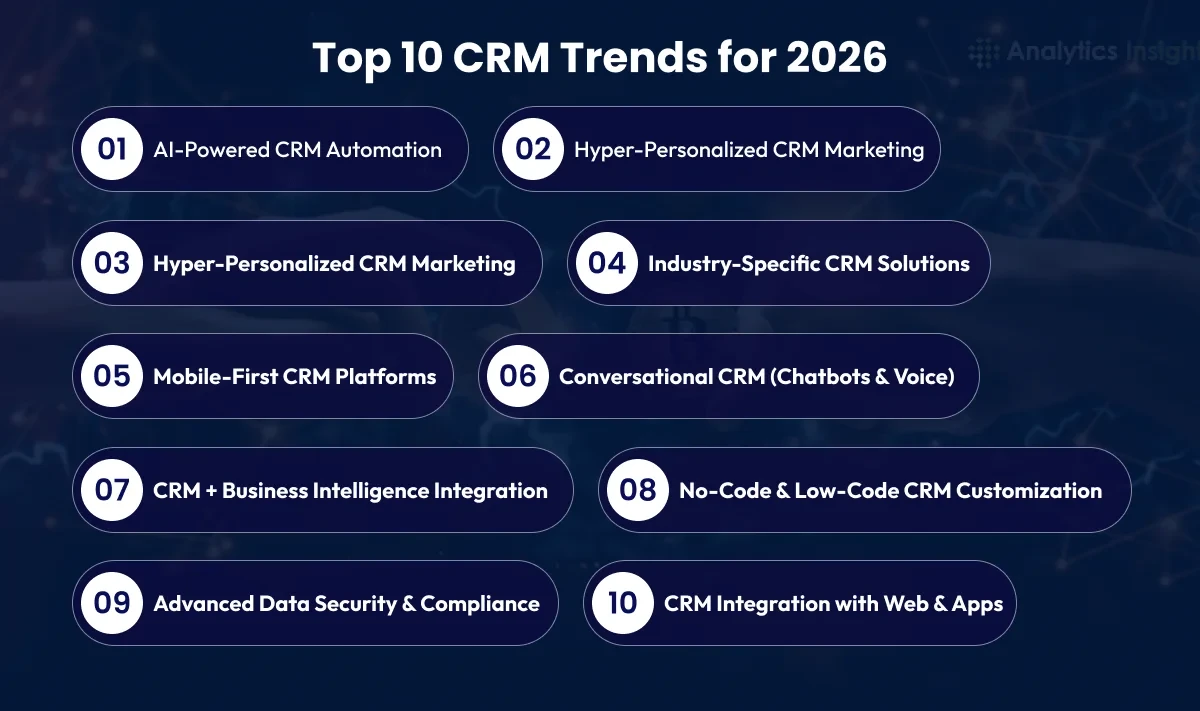
CRM in 2026 is undergoing a structural shift rather than an incremental upgrade. Modern platforms have evolved from passive, manual record-keeping databases into proactive operational engines driven by multi-agent AI, outcome-based pricing, and shared digital collaboration workspaces. As Kate Leggett, a Forrester analyst analyzing enterprise platform transitions, observed:
“CRM in 2026 is undergoing a structural shift, not just an incremental evolution”
Forrester research indicates that 70% of companies already deploy artificial intelligence capabilities within their customer relationship software, moving enterprise commercial operations past disconnected pilot experiments into fully integrated production environments.
The Core Shift: Why CRM Is No Longer a Database
In 2026, CRM has evolved from a passive record-keeping database into an active operational engine. Rather than relying on manual data entry from sales reps, modern CRM systems autonomously analyze customer signals, synchronize shared digital deal rooms, and coordinate cross-departmental tasks across marketing, sales, and service using embedded task-specific AI agents.
From Passive Repositories to Autonomous Engines
The traditional concept of customer relationship software functioned as an administrative ledger. Sales reps spent hours logging phone calls, copy-pasting email summaries, and updating pipeline probabilities. That paradigm has broken down entirely under the weight of operational friction and delayed data entry. According to research from Gartner, task-specific AI agents will be incorporated into 40% of enterprise applications by the end of 2026. Furthermore, Gartner estimates that 80% of enterprises will have deployed generative AI within active production architectures by late 2026.
CRM implementation specialist Frigat NET detailed the operational scope of this transition:
“Modern CRM has already evolved beyond being a simple customer database. Today, it is a technological system that helps companies navigate data faster, build customer relationships more precisely, and use resources more rationally.”
Instead of waiting for a commercial account manager to update an opportunity stage, algorithmic systems continuously evaluate buyer engagement, telemetry data, and product-usage triggers to surface pipeline health and execute automated next steps.
The Rise of Shared Digital Deal Workspaces
Customer engagement channels have expanded far beyond isolated email chains and manual calendar scheduling. Gartner projects that more than 80% of enterprise sales cycles will involve at least one shared digital workspace by late 2026. These mutual collaboration spaces act as central operating environments where vendor sales teams, procurement leads, technical architects, and enterprise buyers collaborate in real time.
Shared digital deal rooms synchronize customer-facing collateral, pricing proposals, and security verification audits into a unified interface tied directly to the underlying CRM schema. As buyers interact with shared documentation, embedded automation updates internal opportunity records, adjusts win probabilities based on document velocity, and alerts account executives to deal stalling before human observation catches the slowdown.
Market Realities: SaaS CRM Growth and Segment Leaders
Enterprise commercial investments reflect the technical re-architecture of customer platforms. Industry data values the SaaS CRM market at $77.13 billion in 2026. The sector is projected to reach $224.43 billion by 2035, compounding at an annual growth rate (CAGR) of 12.60%. Parallel analysis on the CRM professional market tracks a consistent rise, growing from $45.2 billion in 2024 to $47.8 billion in 2025, and heading toward $92.4 billion by 2033 at an 8.2% CAGR.
Enterprise spending across deployment types and functional segments displays several dominant patterns:
- Sales Force Automation Dominance: The sales force automation segment commands a 30% share of total SaaS CRM revenue, remaining the central foundation for commercial teams automating core pipeline execution.
- Marketing Automation Acceleration: Holding 20% of the overall market in 2025, marketing automation represents the fastest-expanding application tier, with a projected CAGR of 13.5% through 2035.
- Cloud-Native Infrastructure: Public cloud infrastructure accounts for 70% of enterprise CRM software distribution, reflecting the scalable compute and memory requirements necessary to operate real-time customer data models.
- Regional Trajectories: North America holds commercial leadership with 38% market share, while the Asia Pacific market is expanding at the fastest pace globally, advancing at a 15.5% CAGR between 2026 and 2035.
- Market Providers: Enterprise infrastructure continues to concentrate around major providers, including Salesforce, Inc., Microsoft Corporation, Oracle Corporation, SAP SE, and Zoho Corporation.
- AI Implementation Share: Industry forecasts indicate that AI-driven personalization and automation will constitute over 50% of all new CRM implementations by 2030.
How Multi-Agent Orchestration Executes Sales Workflows
Multi-agent CRM orchestration deploys specialized autonomous software agents that execute revenue workflows across systems without human intervention. By analyzing pipeline signals and customer data, these agents triage inbound leads, prepare dynamic CPQ quotes, and update core CRM records, compressing multi-day enterprise sales cycle times down to minutes.
Production Agentic Workflows vs. Pilot Sandboxes
Commercial teams spent 2025 running small-scale artificial intelligence experiments, primarily focusing on prompt-driven email composition and meeting summaries. Analysis published by CIO confirms that agentic AI in 2026 has transitioned from exploratory pilots to production enterprise deployments. Industry research indicates that autonomous AI agents compress enterprise process cycle times from days or hours down to minutes or seconds by executing complex cross-system actions directly.
Major software vendors have rebuilt their commercial architectures around this operational reality. In January 2026, Salesforce, Inc. expanded its AI-powered platform tools, embedding autonomous features to coordinate multi-step workflows, generate predictive account insights, and automate customer engagement. Microsoft Corporation upgraded Dynamics 365 with Copilot AI features in March 2026, providing automated operational insights and customer service orchestration. In the mid-market and SMB space, tools like the Pipedrive AI Sales Assistant analyze rep interaction histories to recommend specific follow-up actions and surface high-probability accounts.
Cross-Functional Agent Hand-offs
The technical advantage of multi-agent architecture lies in task specialization and automated hand-offs. Rather than running a single, generalist language model across every business function, enterprise platforms deploy networks of distinct, task-specific agents connected via application programming interfaces (APIs) and enterprise middleware.
In a standard 2026 workflow, an inbound marketing agent verifies lead qualification against account intent signals, routes the profile to an enrichment agent powered by Symantra to populate organizational charts, and alerts a CPQ pricing agent to generate an initial contract scope based on inventory availability retrieved from back-end ERP systems. Hands-free voice command interfaces now permit commercial reps to update complex CRM data and trigger cross-agent task strings directly from mobile environments, removing manual record editing from daily sales operations.
The Transition from Per-Seat to Outcome Pricing
The traditional per-seat SaaS monetization model faces structural obsolescence as autonomous systems handle higher proportions of revenue operations. When specialized software agents perform research, lead qualification, and customer follow-up previously assigned to entry-level representatives, paying software vendors strictly per human login creates an economic mismatch. In April 2026, Marc Benioff pointed out that artificial intelligence is reinforcing SaaS CRM operating frameworks, emphasizing a marked industry transition toward outcome-based pricing models and deeper functional AI integration.
Industry analysis in CIO documents that seat-based licensing is shifting toward blended structures that combine base software access with consumption, active software agents, and verified commercial resolutions. Revenue Operations (RevOps) leaders must adapt financial forecasting models accordingly. Budgeting now requires evaluating hybrid expense structures: baseline platform retainers paired with consumption-driven costs, such as API request volumes, model inference token allocations, and fees tied directly to resolved customer service tickets or qualified pipeline opportunities.
Operationalizing Autonomy: The Tiered CRM Workflow Matrix
Integrating autonomous agents into a commercial engine requires operational discipline. Granting unmonitored execution authority to AI agents creates compliance, data integrity, and customer relationship liabilities. Conversely, demanding manual verification for every operational micro-task eliminates the efficiency gains of modern software. Performance benchmarks published by Coworker AI show that automating context retrieval and account data enrichment saves sales professionals 8-10 hours per week in non-selling administrative tasks.
To safely capture these productivity dividends, RevOps leaders must divide their revenue architecture into distinct operating tiers based on risk, system permissions, and oversight requirements.
The following comparison table outlines how enterprise CRM architecture has evolved across technical delivery models, pricing structures, and implementation challenges:
Operating Model |
Core Mechanism |
Primary Commercial Structure |
Key Implementation Bottleneck |
|---|---|---|---|
Legacy Monolithic CRM |
Centralized relational database dependent on manual rep data entry |
Fixed per-seat, per-month licensing |
Low rep adoption, obsolete pipeline data, and bloated custom schema debt |
Composable Micro-SaaS CRM |
Decoupled best-of-breed point solutions connected via APIs |
Fragmented multi-vendor subscriptions and integration connectors |
Data silos, synchronization latency, and unaligned governance frameworks |
Agentic Autonomous CRM |
Multi-agent orchestration operating over centralized, unified customer data |
Hybrid base access fees combined with consumption and outcome-based pricing |
Schema inconsistency, agent loop runaway, and compliance oversight deficits |
Evaluating these structural choices clarifies how modern platforms balance autonomy against architectural control. Commercial teams can establish governance by grouping everyday revenue workflows into three practical operational levels:
Autonomy Tier |
Operational Workflows |
Execution Mechanism |
Human Oversight Level |
|---|---|---|---|
Tier 1: Full Autonomy |
Activity logging, contact deduplication, calendar scheduling, basic onboarding verification |
Unattended autonomous software agents operating via event-driven API triggers |
Zero human review; automated audit logs flagged only on system exceptions |
Tier 2: Human-in-the-Loop |
Pre-call briefing generation, low-code quote assembly, personalized outreach drafting, re-engagement campaigns |
Co-pilot drafting and contextual retrieval with staging in CRM interface |
Mandatory human review and approval prior to external communication or contract delivery |
Tier 3: Strictly Human |
Non-standard contract discounting, high-value renewal escalations, complex enterprise negotiations |
Algorithmic decision support, margin analysis, and predictive deal-risk scoring |
Full human ownership; autonomous tools restricted to data presentation and modeling |
Applying this tiered matrix ensures that administrative tasks run automatically while strategic enterprise relationships and commercial pricing controls remain protected by senior revenue professionals.
How Can Enterprise Teams Avoid Composable CRM Chaos?
Enterprise IT and RevOps teams increasingly deploy composable software stacks—connecting modular marketing, sales, and service tools around customer data platforms such as Treasure Data, Keap, and Coworker AI. Treasure Data utilizes diamond record methodologies to establish identity resolution, providing unified records across enterprise touchpoints. When composable stacks lack central data hygiene and unified governance, they descend into disconnected architectures that undermine pipeline visibility.
Enterprise architect Basil Malik addressed this tendency toward unmanaged technical expansion, emphasizing that:
“less is more.”
Malik documented that the majority of CRM implementation failures are caused by skipping operational fundamentals rather than lacking advanced technology features. Piling autonomous agents on top of unstandardized custom fields, duplicate company records, and unverified data leads to algorithmic hallucinations in customer-facing interactions.
To avoid architectural breakdown, RevOps leaders must execute targeted, phased rollouts. Organizations should audit legacy systems, deprecate unused fields, standardize validation rules, and establish zero-trust security permissions before granting AI agents access to write or alter customer records.
FAQ
How does the EU AI Act affect automated CRM lead scoring in 2026?
Predictive customer profiling and algorithmic deal prioritization fall under enhanced transparency standards in 2026. RevOps teams must maintain explainable AI audit trails, eliminate automated scoring bias, and permit human overrides on customer scoring decisions to comply with regulatory mandates.
How are sales compensation and commissions adjusted for autonomous AI deals?
Revenue teams resolve sales attribution conflicts by shifting to hybrid compensation models. Common structures include AI-assisted commission tiers, elevated baseline production quotas, and paying commercial reps based on strategic pipeline management and account expansion rather than routine manual touchpoints.
What is the primary technical cause of agentic CRM deployment failure?
Deploying autonomous multi-agent systems over unstandardized legacy schemas, duplicate customer records, and ungoverned permissions causes deployment failure. Without clean underlying data, agents suffer from synchronization latency, circular execution loops, and inaccurate automated customer communication.
Will outcome-based pricing increase overall CRM total cost of ownership?
Moving from predictable per-seat licenses to usage-, agent-, and resolution-based pricing causes budget volatility if unmanaged. Enterprise teams risk higher total ownership costs without active tracking of token consumption, API request limits, and rogue agent task loops.
What impact do autonomous AI agents have on enterprise process cycle times?
Autonomous AI agents compress enterprise process cycle times down from days or hours to minutes or seconds by executing cross-system data updates, generating quotes, and resolving operational requests without human hand-off delays.
What percentage of enterprise sales cycles will use shared digital workspaces?
More than 80% of enterprise sales cycles will involve at least one shared digital workspace by late 2026, establishing continuous collaborative spaces between enterprise buyers, vendor sales teams, and embedded software agents.