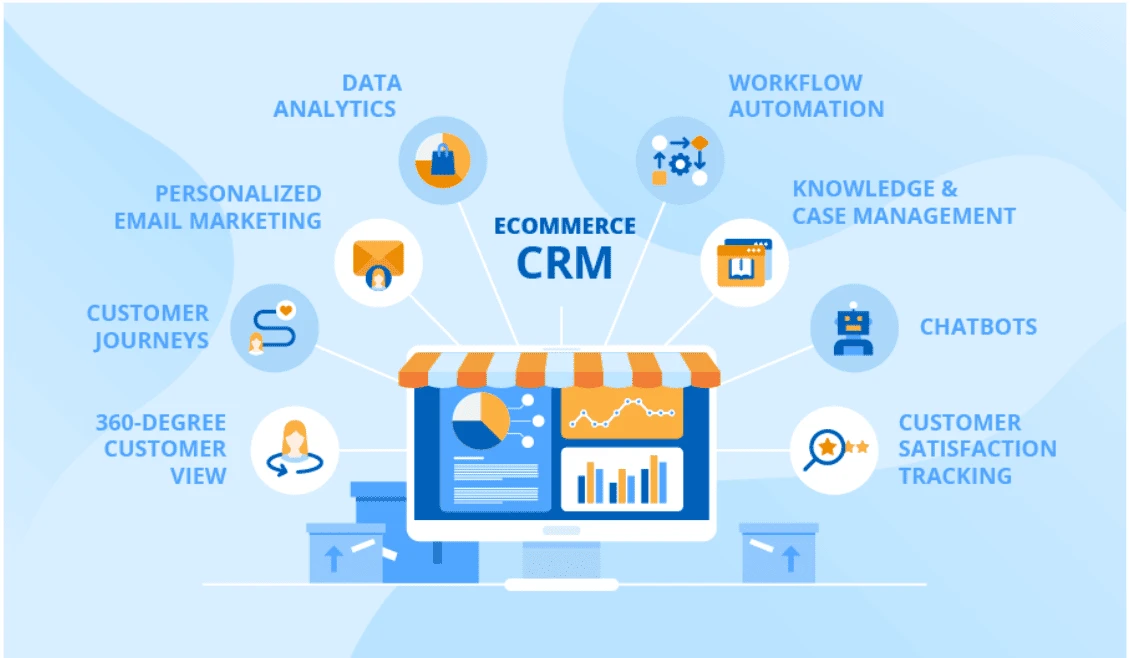
An ecommerce CRM is a specialized system designed to act as a single source of truth for customer data, behaviors, and habits. Unlike traditional B2B CRMs built for long sales cycles, ecommerce CRMs are engineered for high transaction volumes, rapid behavioral triggers, and the transition of anonymous visitors into known buyers. According to Vtiger, for e-commerce businesses, a CRM is no longer optional.
How Ecommerce CRM differs from traditional B2B systems
Ecommerce CRMs differ from traditional B2B CRMs by focusing on high transaction volumes and rapid behavioral triggers that fire in minutes rather than weeks. While B2B systems manage long-term contracts and sales pipelines, ecommerce CRMs track anonymous-to-known buyer journeys and real-time digital touchpoints to drive immediate conversions.
The fundamental shift lies in the operational cadence. B2B systems are designed for lead nurturing over months, whereas an e-CRM must analyze data continuously to react to a user’s immediate intent. This allows businesses to move beyond simple personalization, such as using a customer’s first name, toward targeted marketing based on actual behavior.
Feature |
Traditional B2B CRM |
Ecommerce CRM |
|---|---|---|
Operational Focus |
Long-term sales pipelines |
Online sales and customer experience |
Transaction Volume |
Low volume, high contract value |
High volume, rapid transactions |
Trigger Speed |
Weeks or months |
Minutes or hours |
Buyer Journey |
Lead nurturing and qualification |
Anonymous-to-known transition |
This structural difference ensures that an ecommerce-specific tool can handle the velocity of digital storefronts without the lag inherent in systems built for manual account management.
All-in-One Platforms vs. Integrated Best-of-Breed
Choosing between a unified platform and a modular stack depends on whether a business prioritizes immediate deployment speed or long-term architectural flexibility.
The All-in-One approach: Simplicity and speed
Platforms like Checkout Champ provide built-in CRM capabilities, which eliminates the need to sync data between separate software packages. This approach reduces operational inefficiency caused by juggling customer information across separate spreadsheets, email platforms, and ecommerce backends. By housing the storefront and the customer database in one environment, businesses can deploy faster and avoid the initial complexity of API mapping.
The Integrated approach: Flexibility and scale
Many scaling businesses prefer a “Best-of-Breed” setup, pairing a dedicated storefront like Shopify or WooCommerce with a specialized CRM such as Zoho CRM, Vtiger CRM, or Freshmarketer. This modularity allows a company to select the most powerful tool for each specific function. Native integrations between these platforms decrease the need for development team interventions, which lowers software expenses and increases overall operational efficiency.
However, the integrated approach introduces a critical risk regarding “unified identity.” When a business expands into new sales channels—such as retail pop-ups, wholesale, or third-party marketplaces—without a central CRM to maintain a single customer ID, every new channel effectively starts from scratch. The integrated approach requires a disciplined data strategy to ensure a customer who buys at a pop-up is recognized as the same user who shops on the website.
- Operational Simplicity: All-in-one platforms reduce the “tech stack” overhead.
- Scaling Power: Integrated setups allow for deeper customization of the sales funnel.
- Identity Management: A dedicated CRM is essential for maintaining a consistent customer profile across omnichannel touchpoints.
Turning data into revenue: Key implementation techniques
To drive ecommerce revenue, CRMs use customer profile creation from digital touchpoints, RFM scoring for retention, and behavioral automation. By segmenting clients based on browsing habits and purchase value, businesses can move beyond simple personalization to targeted marketing that predicts the performance of new product launches.
The first step in this process is building a 360-degree customer profile. This involves collecting data from various digital touchpoints—including website visits, product views, order history, payment methods, and live chat—and organizing them into detailed profiles that include personal preferences and support ticket history. This depth of data allows marketers to understand the “why” behind a purchase, not just the “what.”
Once profiles are established, businesses apply retention strategies such as RFM scoring (Recency, Frequency, Monetary value) and behavioral triggers. While positive triggers (like a repeat purchase) drive growth, a sophisticated strategy also utilizes “negative triggers”—behavioral signals that indicate a customer is at risk of churning. For example, a CRM can trigger a win-back sequence when a high-value customer’s activity drops below their usual frequency or send a targeted offer to a user who has become inactive, preventing the loss of lifetime value (LTV).
Advanced implementation also includes customer segmentation based on the following criteria:
- Browsing Activities: Targeting users who view specific categories but haven’t purchased.
- Buying Habits: Identifying repeat buyers for loyalty rewards.
- Purchase Value: Separating “whales” from low-average order value (AOV) customers.
- Lifecycle Stage: Tailoring messages for new signups versus long-term advocates.
These techniques enable a business to analyze customer preferences with enough precision to predict how a new product launch will perform among specific segments before the product even hits the market.
Avoiding the ‘Integration Failure’: Common pitfalls
The technical connection between a storefront and a CRM is only as effective as the human processes supporting it. Many businesses experience “integration failure” not because the software broke, but because of poor employee training, a lack of clear business goals, and a failure to maintain accurate, complete data.
One of the most common operational failures is the persistence of data silos. When teams continue to rely on separate spreadsheets for certain tasks while the CRM is active, the “single source of truth” is compromised. This leads to fragmented customer experiences and wasted marketing spend.
Finally, businesses must recognize that a CRM is not a “set it and forget it” tool. Without a commitment to data hygiene and staff training, the system becomes a costly database of outdated information rather than a revenue-generating asset. Success requires aligning the CRM’s capabilities with specific, measurable business objectives.
FAQ
What is the difference between a CRM and an ERP for ecommerce?
An ERP (Enterprise Resource Planning) focuses on back-office functions such as HR, finance, and inventory management. In contrast, a CRM (Customer Relationship Management) focuses on the front-office, housing customer data specifically to drive sales and marketing efforts.
Which CRMs are best for ecommerce startups?
For startups requiring lightweight and efficient options, Vtiger CRM, Zoho CRM, and Freshmarketer are identified as suitable choices to manage early-stage customer growth.
Can a CRM actually reduce business costs?
Yes. A CRM reduces costs by better recording customer sales to prevent revenue loss and by utilizing native integrations that decrease the need for expensive development team interventions.