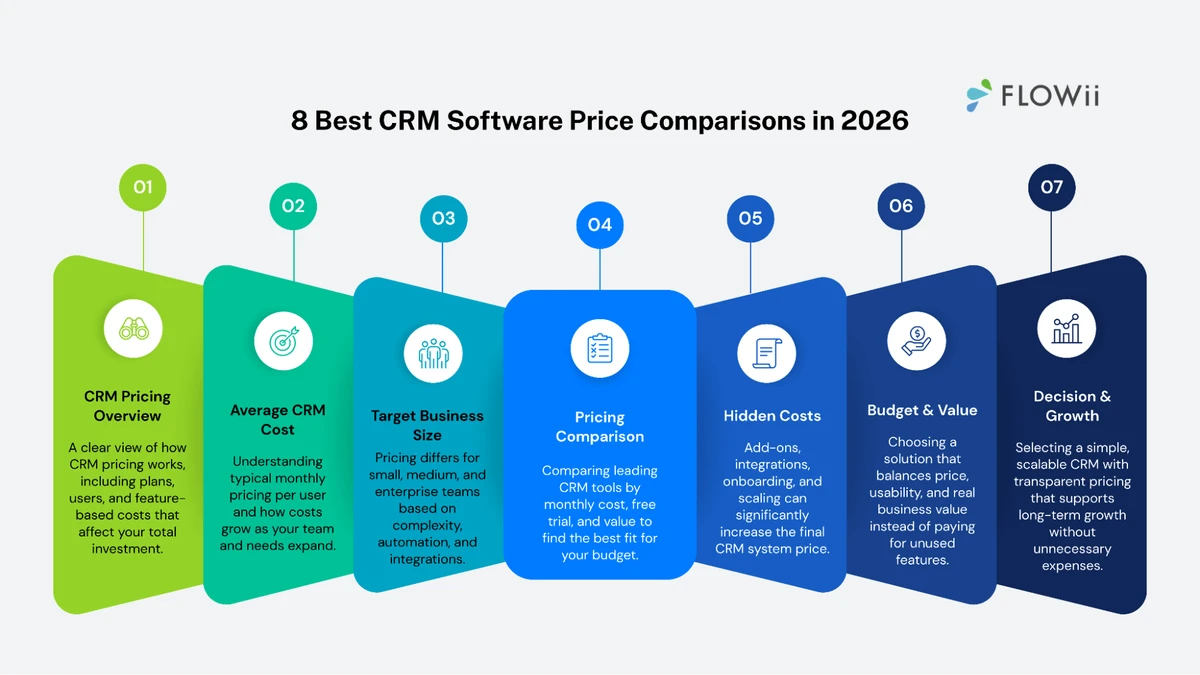
In 2026, CRM pricing is split between three primary tiers: small teams ($10–$30/user/month), mid-market ($40–$100/user/month), and enterprise ($150–$1,000+/user/month). While ‘sticker prices’ vary, the true cost is driven by implementation fees and AI usage billing, which can add thousands to the first-year budget. Grand View Research projects the CRM market value will surpass $100 billion by 2027, reflecting a massive shift toward AI-integrated pricing models.
Quick Verdict: Best CRM by Budget and Use Case
For ultra-low budgets, Saleoid is the most affordable at $5/month. For AI-forward teams wanting flexible data models, Attio is recommended over HubSpot. For organizations requiring high-volume AI automation and complex agentic workflows, Salesforce is the primary recommendation, though users should budget for usage-based volatility beyond the initial bundle. Enterprise-grade power is led by Salesforce (Unlimited at $350/user/month) and Microsoft Dynamics 365 Sales Enterprise ($105/user/month).
Choosing a vendor based solely on the monthly seat price often leads to budget overruns. For instance, while entry-level options provide basic contact management, high-growth teams typically require the advanced automation and custom objects found in Professional or Enterprise tiers to avoid operational bottlenecks.
Vendor |
Entry Price |
Enterprise Price |
Best For |
|---|---|---|---|
Saleoid |
$5/month |
N/A |
Ultra-low budgets |
Microsoft Dynamics 365 |
N/A |
$105/user/month |
Enterprise ecosystems |
Salesforce |
N/A |
$350/user/month (Unlimited) |
Maximum scalability |
HubSpot |
Free tier available |
$3,600/month (Marketing Hub Enterprise, 5 seats) |
Integrated marketing/sales |
The 2026 Pricing Landscape: From $5 to $1,000+
- Small Teams: Budget options typically range from $10 to $30 per user/month. At the extreme low end, Saleoid provides a solution for $5/month.
- Mid-Market: Medium businesses generally spend between $40 and $100 per user/month to access advanced workflow automation.
- Enterprise: Large-scale deployments range from $150 to over $1,000 per user/month. For example, Salesforce Enterprise is priced at $175/user/month, while the Unlimited tier reaches $350/user/month.
For organizations seeking a middle ground, average spending in the US is reported between $60 and $180 per user monthly. This variance is often due to the addition of specialized modules or higher-tier support packages that accompany the base license.
Beyond the Subscription: Calculating True Total Cost of Ownership
True CRM cost includes the subscription plus implementation fees ($1,200–$5,000), data migration, and third-party middleware. To avoid budget failure, calculate the 3-year TCO rather than monthly rates, as integration and API costs are typically billed separately from core licenses in 2026.
The gap between the “sticker price” and the actual expenditure is a frequent point of failure in procurement. Techcronus notes that the biggest mistake businesses make during a CRM price comparison is assuming the subscription fee is the total cost. When a company ignores onboarding, training, and custom workflows, the initial budget becomes inaccurate.
To determine a realistic 3-year Total Cost of Ownership (TCO), practitioners recommend a comprehensive calculation that includes:
- Implementation Fees: Professional services for setup and configuration typically range from $1,200 to $5,000.
- Migration Costs: Moving legacy data from a previous system often requires paid specialists or middleware.
- API and Data Costs: In 2026, API usage, data enrichment, and third-party AI tool integrations remain priced separately from the core license.
The Dench Team asserts that CRM pricing is confusing by design, which is why shifting the focus to a three-year projection is the only way to identify the true financial impact of a platform choice.
AI Pricing: Flat Fees vs. Usage-Based Volatility
AI integration has introduced a new layer of financial unpredictability, moving away from traditional flat-fee models toward consumption-based billing.
- Predictable AI: Some vendors bundle AI features into a flat monthly tier, allowing for stable budgeting.
- Usage-Based AI: Some platforms utilize usage-billing for AI activity that exceeds the initial bundle. This can cause cost predictability to break, as expenses fluctuate based on the volume of AI-driven interactions.
This shift means that “AI-powered” is no longer a binary feature but a variable cost. Organizations must monitor token usage and interaction volumes to prevent unexpected monthly overages.
The ‘Growth Penalty’ and Scaling Pitfalls
As companies scale, the pricing structure of a CRM can either facilitate growth or act as a financial deterrent, often referred to as the “growth penalty.”
- Per-User Restrictions: Per-user pricing can create workflow problems by restricting data access to save money. Organizations may limit who can see critical data simply because adding new logins increases the monthly bill.
- Per-Contact Risks: In the nonprofit sector, per-contact pricing can create a counterproductive incentive to delete donor history just to stay under a specific pricing tier. This is particularly damaging for long-term relationship management.
- The Bundle Advantage: Flat or modular bundles reduce the growth penalty compared to per-user software, which can become a substantial fixed expense once a team reaches 10 or 20 users.
These challenges are especially acute for nonprofits, where 60% of executive leaders cite cost as their primary technology infrastructure challenge. For small nonprofits, annual subscription costs typically range from $1,200 to $5,600, with mid-tier options falling between $1,200 and $3,600 per year. To mitigate these risks, businesses can leverage annual billing, which typically offers savings of 15-25% compared to monthly plans in early 2026.
FAQ
How much does a typical CRM implementation cost in 2026?
Estimated implementation fees range from $1,200 to $5,000. These costs are often priced separately from the core software licenses and cover onboarding and configuration.
What is the most affordable CRM for a small business?
Saleoid is identified as the most affordable option in the sampled group, with a price point of $5/month.
Why is nonprofit CRM pricing different?
Nonprofit pricing is often complex and difficult to compare. 60% of nonprofit leaders cite cost as a primary challenge, often dealing with per-contact pricing that may incentivize the deletion of donor history to remain within a budget tier.
How can I save on annual CRM subscriptions?
Switching from monthly to annual billing typically provides savings of 15-25% in early 2026.